Montreal teen in critical condition after near-drowning at school pool
A 13-year-old Montreal student remained in critical condition after being found at the bottom of a swimming pool following a high school gym class.
The incident happened during a Grade 8 physical education class at the city-run pool adjacent to Père-Marquette high school. When the class ended and students left the pool deck, no one noticed the boy was missing. He was discovered only when the next group of students arrived.
A school board official confirmed that both a teacher and a lifeguard were present, along with approximately 20–30 students.
This summary is based in part on reporting from the Montreal Gazette. You can read the original article here:
‘We’re waiting for word’: Montreal teen in critical condition after near-drowning
Emergency response and school support
First responders reported that the teen was in cardio-respiratory arrest when they arrived. They were able to resuscitate him before transporting him to hospital, where he remains in critical condition. The lifeguard on duty was also taken to hospital to be treated for shock.
The local borough has since closed the pool indefinitely while the incident is reviewed.
To support the school community, the Montreal school board sent a psychological support team to work with students and staff. According to spokesperson Alain Perron, the team remained available in the days following the event as everyone waits for updates from the hospital and the boy’s family.
Police have stated that there is no criminal investigation at this time.
Safety review and questions about what happened
While police are not pursuing charges, experts in aquatic safety have indicated that a deeper review of the circumstances is likely.
The Quebec branch of the Lifesaving Society has suggested that any probe would typically look at several factors, including:
The design and condition of the pool
The lighting and visibility in the facility
Safety equipment on site
Supervision practices during the class
The child’s medical history and swimming ability
According to the Lifesaving Society, the supervision ratio appears to have met provincial standards: a physical education teacher and a lifeguard were present for a group of 30 or fewer students. In Quebec, teachers with an appropriate degree must complete a minimum number of hours in aquatic and lifesaving courses to teach in the pool without assistance up to that class size. If those criteria aren’t met, a certified lifeguard must assist from the pool deck.
Even when standards are followed, near-drowning incidents can still occur, which is why best practices also stress:
Assessing each student’s swimming ability at the very first class
Grouping students based on skill level and comfort in the water
Constantly scanning the pool and counting heads
Ensuring students understand and follow pool rules
Indoor pool incidents are statistically rare, but as aquatic safety experts often point out, even a single drowning or near-drowning is one too many.
Why early CPR and first aid are critical in drowning emergencies
In drowning and near-drowning situations, every second counts. When someone is pulled from the water unresponsive and not breathing, immediate action can be the difference between life and death, or between full recovery and permanent brain injury.
Key steps include:
Recognizing the emergency quickly – a silent, motionless person in the water is an emergency.
Calling 9-1-1 (or local EMS) immediately.
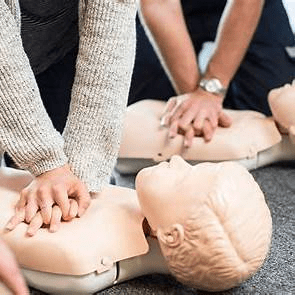
Starting CPR if the person is not breathing or has no pulse – chest compressions and rescue breaths can help maintain circulation and oxygen until paramedics arrive.
Using an AED (automated external defibrillator) if one is available and the person is in cardiac arrest.
Cardiopulmonary resuscitation (CPR) is a life-saving skill that anyone can learn. In this case, first responders were able to resuscitate the boy—an outcome that underscores how vital effective CPR can be.
How you can prepare: learn first aid and CPR
You don’t have to be a healthcare professional or lifeguard to make a difference. With proper training, you can:
Recognize the signs of drowning and cardiac arrest
Respond confidently while waiting for emergency services
Perform high-quality CPR and use an AED
Provide first aid for common emergencies at home, work, school, or in the community
If you are in Calgary or the surrounding area, you can build these skills by enrolling in the Courses are designed for parents, teachers, coaches, lifeguards, and anyone who wants to be ready to help in an emergency.
Take action before an emergency happens.
Register in a first aid and CPR course today so you’re prepared to help when every second counts.
Learn more about drowning, cardiac arrest, and first aid
For general information on drowning, cardiac arrest, and first aid, you can visit:
Serving Calgary and the surrounding areas the lowest priced, highest quality OH&S approved first aid training, CPR and food safety courses for over 15 years!
 Support locally-owned and Canadian-operated businesses, with no partnerships or links with American corporations.